
Optimizing Tree-sitter for End-to-End ast-grep Performance
Part 4 of 4 — end-to-end validation
Thirty percent faster. Slower where it mattered.
First, the premise, for anyone landing on this post directly. Tree-sitter is a parser framework: it turns source code into syntax trees that tools can query. This series follows a rewrite of its C runtime in Rust—behind the same binary interface, so existing grammars keep working—for ast-grep, the structural code-search tool built on top of it. As throughout the series, I directed the experiments and ChatGPT wrote the code. This is the finale, where the application finally gets its say.
The previous post reached what should have been a victory. The project measured itself with gates—pass/fail benchmark thresholds a change had to clear before it was retained—and the parser-only gate, a seven-language parsing benchmark, put the Rust core roughly 30% ahead of C. Then ast-grep used the same runtime to scan a real TypeScript repository and ran slower than its C-backed build. That contradiction is the subject of this final post.
The parser benchmark had not lied. It had measured one phase of a larger system: parse already-loaded source with a ready parser, then stop when the tree is returned. ast-grep also creates and configures parsers, sets up and tears down per-parse memory across thousands of files, and traverses every completed tree. The Rust rewrite had made the measured phase faster while moving new costs into work the benchmark never saw.
Finding those costs meant expanding the measurement one boundary at a time until “faster” covered the whole application. It ends well—the exact numbers wait at the finish line—but the road there runs through a virtual-memory storm, a gigabyte of retired arenas, and garbage that turned out to be the wrong garbage.
One measurement convention carries through everything that follows: unless a comparison says otherwise, each change is judged against the Rust revision immediately before it. C answers the broad rewrite question, not whether one new Rust branch helped.
First, prove the contradiction
Before profiling, I had to rule out the boring explanation: perhaps ast-grep was not actually using the local runtime. ChatGPT rebuilt it from my Tree-sitter checkout, verified the Rust arena symbols in the binary, compared its output, and reran the opencode outline workload: ast-grep parsing opencode, a real-world TypeScript repository, and walking every parsed file's tree to extract an outline.
The binary was correct. The output matched. The contradiction survived.
So the instruction changed: stop optimizing and profile the complete lifecycle—not only ts_parser_parse. The parser gate ended when a tree was returned; the application also paid for parser setup, arena creation and release, and reading that tree. From here onward, “faster” needed separate evidence for construction, parsing, traversal, and the complete application.
The 4 GiB arena was “only virtual” 2,291 times
The runtime allocates syntax nodes from an arena: one big buffer with a cursor, where allocating means bumping the cursor forward and everything is released at once when the buffer is. The first arena reserved a 4 GiB virtual address range with mmap. It committed 64 KiB chunks with mprotect as the bump cursor advanced, then released the mapping with munmap.
This looked reasonable in the parser benchmark:
- virtual reservation was not resident memory;
- only touched chunks became physical pages;
- one reused parser amortized reserve and release; and
- physical footprint remained small.
Then ast-grep created a parser for each file.
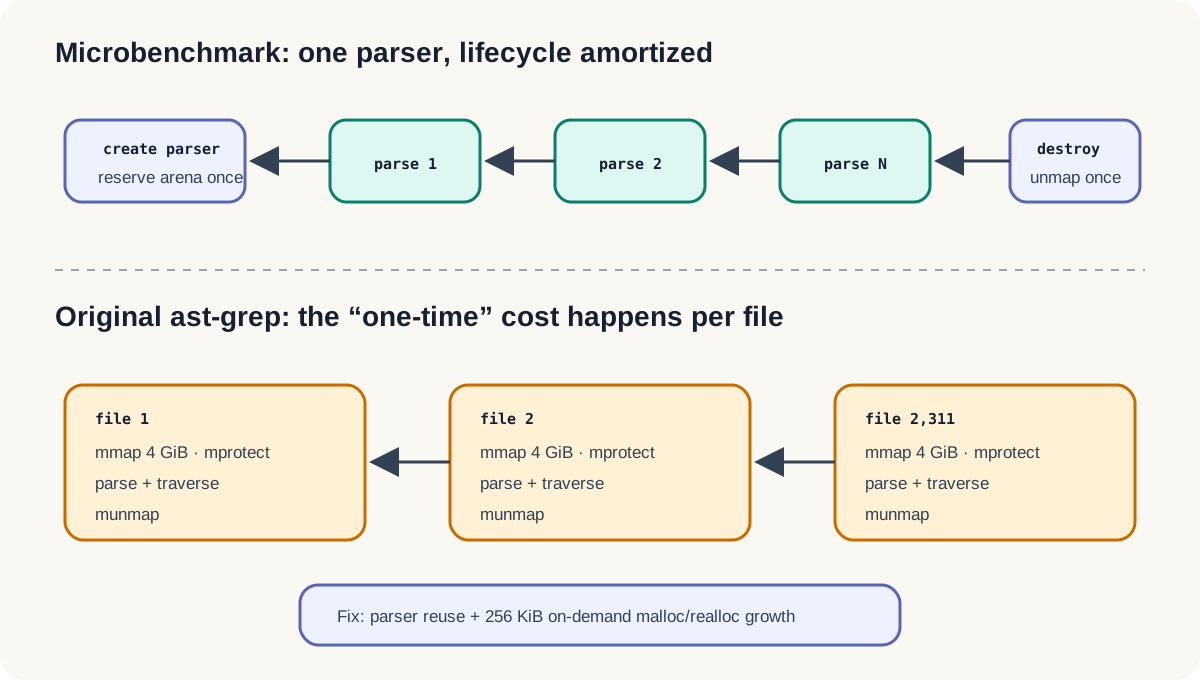
ChatGPT returned with the syscall trace. There it was: the “one-time” virtual-memory setup was happening once per file. Thousands of times.
On opencode's 2,311 TypeScript files, the arena and normal builds produced:
| System call | Arena build | Normal build |
|---|---|---|
mmap | 2,329 | 34 |
mprotect | 10,086 | 38 |
munmap | 2,305 | 23 |
Matching each 4 GiB reservation against its corresponding release paired up 2,291 full reserve-plus-64-KiB-commit arena lifecycles—nearly one per file; the leftover calls were ordinary allocator and loader traffic. The trace followed them from subtree_pool_ensure_arena (a subtree is Tree-sitter's record for a single syntax node; the pool is where they live) through leaf construction, parser advance, ts_parser_parse, and finally ast-grep's document creation.
The parser had slightly reduced user-space parse CPU. It had also become an enthusiastic virtual-memory benchmark.
The conclusion changed again. The parser-only measurements were not necessarily false; their lifecycle was incomplete. Good news, in the grim sense: the first end-to-end disaster now had a concrete cause. Concrete causes can be removed.
ast-grep would later reuse parser instances, but caching could not be the core runtime's excuse. Constructing a parser still had to be a reasonable operation for every other caller. The allocator itself had to stop turning each new parser into a 4 GiB virtual-memory ceremony.
Ordinary allocation removed the VM lifecycle
The fix was to make construction ordinary. ChatGPT replaced the 4 GiB virtual reservation with on-demand allocation: a parser now starts with only the arena header, its first syntax record allocates 256 KiB with malloc, and later growth rounds the required size to the next power of two. The arena no longer needed a fixed virtual address because subtree handles—the compact references the runtime hands around instead of raw pointers—were offsets from its current base.
The first implementation could not yet grow that block with realloc. Subtree handles survived a move, but some temporary SubtreeArray values—growable scratch arrays used to collect child handles during reductions—still stored raw addresses inside the arena. If realloc moved the block, those addresses would point into the old allocation.
As an interim solution, growth allocated a larger block and copied the used bytes into it. The old block remained in a retired chain so its raw addresses would stay valid. This removed the per-file mmap and mprotect calls, but it kept every previous arena generation alive.
That retention was expensive. As the arena grew geometrically, the retired chain accumulated all earlier capacities. On TypeScript's tests/baselines corpus with one ast-grep worker, those old blocks—not the live syntax tree—drove peak RSS to about 1.04 GiB. Removing the VM lifecycle had fixed CPU overhead by creating a much larger memory problem.
Relative offsets made realloc safe
Removing the retired chain required every live arena reference to survive a change of base address. Subtree handles already did. ChatGPT converted the remaining arena-backed arrays from raw addresses to byte offsets, resolving each offset against the arena's current base when accessed. Reusable scratch buffers that did not need arena storage moved to their own malloc/realloc allocations.
Once no live reference depended on the old base, the arena itself could grow with realloc. A forced-relocation test moved the allocation and verified that existing subtree handles and child arrays still resolved correctly. Old arena generations were no longer necessary: one allocation represented the current arena, and one release could free it.
This reduced peak RSS from about 1.04 GiB to 492.2 MiB. It was not free: a matched Rust-to-Rust gate run put the change at −2.14% parse throughput, attributed to resolving movable array offsets on hot reduce paths—memory bought with a little speed, knowingly. The retired chain was gone, so it could no longer explain the remaining half gigabyte. Something inside a single parse was advancing the live arena far beyond the 150 MiB gate—the project's memory budget for this one-worker stress-corpus run, the line peak RSS had to stay under for the memory design to count as acceptable. The ceiling was pre-registered before the experiment ran: generous but finite headroom over the roughly 79 MiB the C-backed build reported on the same corpus. Dead subtree nodes looked like the obvious suspect. The next allocation profile showed that they were not.
I instructed ChatGPT to optimize the wrong garbage
A 273,957-byte TypeScript fixture advanced the arena bump cursor to 474,329,448 bytes, forcing a 512 MiB capacity. Instrumentation showed that all large-arena boundaries had one owner. In plain terms: nothing outside the in-progress parse was holding that memory. Published trees—trees already handed back to the caller, immutable from then on—were not the retainers; the parse itself was.
At my direction, ChatGPT first tried reclaiming uniquely owned nodes at the top of the bump stack—the most recently allocated bytes, the only ones a cursor can cheaply take back. The peak barely moved. The next candidate restored exact reference counts, cascading release, and node-record free lists: lists of released blocks kept around to satisfy later allocations of the same kind. The peak still hovered around 494 MiB.
Two increasingly sophisticated node-reclamation designs. The same roughly 494 MiB peak. Again? Either the instrumentation was wrong or the entire explanation was wrong. I stopped the fix loop and asked ChatGPT to count every byte of bump progress by allocation class.
Allocation counters finally ended the argument:
| Allocation class | Bump progress |
|---|---|
Temporary SubtreeArray capacities | 468.2 MB |
| Everything else combined | about 1.9 MB |
(The rows sum to 470.1 MB, about 4 MB short of the 474.3 MB total measured on the bump-only build: the counters ran on the free-list prototype, where roughly 4.2 MB of node-record allocations were served from free lists and never advanced the bump cursor.)
The GC question changed immediately. The problem was no longer “How do dead subtree nodes return arena space?” It was “Why do temporary child-array capacities never get reused during this one parse?” Same RSS graph. Completely different design axis.
The pathological parse created and replaced large temporary child buffers. Because the arena was bump-only, superseded capacities remained physical until the arena reset for the next parse, even when the logical array had moved on.
The retained fix reused those temporary buffers through free lists—the same idea that had just failed for node records, now pointed at the right allocation class. There are 64 lists, one per exact capacity, enough to span the small child-array sizes the parser commonly requests. When an array grows and leaves its old buffer behind, that block enters the list for its exact capacity. The next array requesting the same capacity takes the block instead of advancing the arena's bump cursor.
The lists are intrusive: because a released block no longer contains live children, its first four bytes store the arena offset of the next available block. This needs neither a separate bookkeeping allocation nor a raw pointer that would break if the arena moved. Reuse starts only after the arena exceeds 16 MiB—a round threshold whose whole job is to keep ordinary small parses on the simpler bump-only path—and published arenas remain immutable.
Peak RSS on the same one-worker ast-grep corpus fell to 91.2 MiB, below the 150 MiB gate. Parse throughput decreased by 1.10% across languages. I kept the change because an order-of-magnitude application memory correction was worth a one-percent parser cost.
After a gigabyte, then half a gigabyte, 91.2 MiB felt like a different runtime.
This is not subtree garbage collection. It is scratch-buffer reuse, selected because the profile named scratch buffers.
Memory was finally below its gate. That still did not settle the original CPU contradiction, because the parser benchmark stopped exactly where ast-grep's next phase began: reading the completed tree.
Construction was only half of the tree's career
The arena representation gave every subtree a four-byte relative offset. Smaller handles reduced traffic while the parser built the tree, but readers now had to add the arena base to each handle before accessing a node. The parse benchmark measured the benefit and stopped before paying that read cost.
Reading needed its own benchmark. The new traversal benchmark parsed each fixture once outside the timed region, then repeatedly walked the completed tree in preorder while reading data typical of an ast-grep consumer:
- kind ID;
- byte range;
- named-node status; and
- error-node status.
The first four-byte indexed version was 2.40% slower than the pre-arena Rust build—the one deliberate exception to the usual control, since the whole representation was under judgment—across all seven languages. The parser had become faster by making its output slower to read.
One possible response was to convert the accepted tree into a second, reader-optimized representation. That would add a full tree pass and duplicate representation logic, so I deferred it while the arena layout was still changing. Two later changes made the arena records less wasteful:
- Internal nodes stopped reserving leaf storage. A full leaf may need bytes from an external scanner—a hand-written lexer extension some grammars use for context-sensitive tokens, preserved through the compatibility work in the migration post—or an error lookahead character, the input character the parser was examining when it recorded an error. A parent node never uses either, so internal and leaf records received separate shapes instead of sharing one record large enough for both.
- Column dependence became lazy. Some tokens depend on their starting column—that is how indentation-sensitive grammars decide where a block ends—and Tree-sitter's editing APIs may need to know whether a parent contains one. The old path propagated that fact into every new parent during reduction. The new path keeps it on leaves and reconstructs the parent's answer from its children only when the editing code asks.
When ChatGPT reran the same traversal benchmark after those changes, the complete kernel was 1.71% faster than the pre-arena Rust build. This was an endpoint comparison, not a claim that either change alone caused the gain. It was enough to rule out an expensive representation conversion.
The new profile still found repeated work in child iteration through the tree cursor, Tree-sitter's stateful API for walking a tree node by node. One cursor step resolved the same parent handle several times: to check the child count, obtain the current child, and read the next child's padding. Published arenas do not move, so the iterator could resolve the parent's child slice once and keep that pointer for the duration of the operation.
That narrow cache improved traversal throughput by 5.43%, with all seven languages positive. In a later outline run, ast-grep used 1.12% less user CPU, added a noise-sized 0.62 MiB of RSS, and produced byte-identical output.
I asked ChatGPT to try two broader caching optimizations. Both failed and were removed:
- Caching a 36-byte bundle of size, padding, flags, and other metadata for every child regressed traversal by about 1.7%.
- Returning a smaller parent-setup bundle—child pointer, child count, and production ID—regressed traversal by about 1.2% in every language.
Both experiments copied more data through the iterator than their avoided lookups were worth. The retained optimization caches only the resolved child address, and only for the cursor operation during which that address is known to remain valid.
With parser construction, arena memory, and tree traversal now measured separately, I asked ChatGPT to profile the complete ast-grep worker again. By then, parser reuse had also changed the application's execution pattern.
Parser reuse moved the hotspot again
The original outline path constructed and configured a parser for every file. ast-grep then began retaining parser instances across files handled by the same worker, so repeated parser and language setup could be amortized. This did not replace the allocator fix—the runtime still needed sane construction—but it removed redundant application work that ast-grep controlled. Profiling before the change had put set_language—the call that installs a grammar into a parser—at 15.8% of worker CPU; in the next profile it measured 0.11%. The change worked so well that it exposed the next layer:
| Exclusive area | Worker CPU |
|---|---|
| Parser action interpreter | 17.5% |
| Lexing | 15.7% |
| Subtree construction | 13.6% |
| Tree-cursor traversal | 11.6% |
| Parser stack operations | 10.4% |
| Reduction functions | 5.2% |
The profile sent the investigation back into the parser. One piece of background first: Tree-sitter compiles each grammar into a generated parser—static parse tables, compressed to save space, that the runtime consults for every token. Those generated tables are what this section is about, and the compression is the cost: tables group symbols sharing a value, then use a short linear scan to find an entry. Parser reuse made that lookup the natural next target, because its preparation cost could now be amortized across files. Cache-like and group-skipping ideas went first; they were small, unstable, or negative across the full language set.
The retained mechanism was not a cache. When a parser installs a language, it materializes direct lookup arrays for the mappings otherwise stored in the grammar's compressed small-state tables. The arrays are parser-private and sparse: states that already have direct table entries need no duplicate. They answer two different questions:
- a nonterminal goto index maps the parent symbol produced by a reduction to the parser's next state, removing compressed scans and improving parse throughput by 2.18%;
- a terminal/action index maps the current lookahead token to its shift, reduce, or other parser action, improving parse throughput by 1.42%.
The terminal index also reduced parser-cached opencode outline user CPU from an average 1.233 seconds to 1.172 seconds—about 5.0%—but increased application RSS by 5.88 MiB. (Readers cross-checking the overview post may notice 1.233 s appears in its results table as the C build's outline CPU. That is a coincidence, not a mislabel: the pre-index Rust build happened to match the C build's outline time to the millisecond.) A 1.42% parser-gate gain surfacing as a 5.0% application-CPU reduction is less strange than it looks. The parser-cached outline profile had shown the action interpreter as the largest single block left—17.5% of exclusive CPU once parser reuse removed set_language—and the terminal index removes exactly the compressed-row scans that block spends its time in. opencode's real files hammer that dispatch path far harder than the gate's fixtures do; in the gate itself, even the TypeScript fixtures gained only 0.86%. The generated language ABI and checked-in parser sources remained unchanged; the opaque parser owned the projection.
That last detail matters. A benchmark-corpus-specific cache learns recent access history and may merely memorize the experiment. A complete sparse projection represents every real mapping in the installed language. Its cost does not depend on whether opencode happens to ask the same question tomorrow.
Let one action remain one action
The action interpreter exposed a second common case. Most parse-table entries contain exactly one action, but the runtime still entered a loop designed for several actions and initialized bookkeeping that only generalized parsing needed.
The retained path dispatches one shift, reduce, accept, or recovery action directly. Entries with several actions still use the complete GLR (Generalized LR) dispatcher—the machinery that lets Tree-sitter pursue several parse interpretations at once when a grammar is genuinely ambiguous, and the subject of the previous post. Measured against the preceding Rust revision, the direct path improved parse throughput by 2.78% across the seven-language corpus, with no meaningful change in peak RSS.
Let ordinary ASCII remain ordinary
Lexing was still 15.7% of the worker profile, and its generic advance routine runs for essentially every source byte. Most bytes were ordinary UTF-8 ASCII, already inside the current input chunk and inside the source range ast-grep had asked Tree-sitter to parse.
So the common case got a guarded shortcut: advance the byte and column directly, then load the next byte without entering the full seek-and-decode path. Newlines, non-ASCII input, chunk boundaries, included-range boundaries (callers may restrict parsing to selected byte ranges of a file), and other encodings still use the complete path. The shortcut improved parse throughput by 2.70% across all seven languages, with no meaningful peak RSS change.
The change stayed inside the runtime. I deferred touching generated lexers—the lexing half of those generated grammar artifacts—because users bring artifacts produced by many generator versions and toolchains; this repository's corpus cannot prescribe how every external grammar must be regenerated.
The profile suggested all three changes; it did not prove any of them. Each result still had to beat the preceding Rust revision across the complete language corpus. By this point, that distinction between a promising profile and a retained optimization governed every performance claim.
The benchmark rules stopped being optional
These rules did not arrive at the end of the project; they hardened the moment they were needed. The early /goal improve the perf by 20% phase had produced overlapping changes whose results were hard to attribute, and the wrong-garbage episode—two sophisticated fixes for a problem the profile had never named—turned the habits into requirements. Every experiment above already ran under them. Each ChatGPT-generated candidate had to answer a narrower brief:
- What exact operation disappears?
- Which immediately preceding Rust revision is the control?
- Which invariant could the optimization accidentally skip?
- Which corpus and lifecycle exercise the change?
- What result kills the idea?
ChatGPT could still write the patch and run the machinery. It could no longer declare victory with a fast number from a different architecture: the control was always the immediately preceding Rust revision, exactly as the convention at the top of this post promised. The gate covered 40 checked-in fixtures across C++, Go, Java, JavaScript, Python, Rust, and TypeScript. Samples used process CPU time, calibrated duration, medians, standard deviation, and a five-percent coefficient-of-variation limit.
Correctness gates included core fixtures, ABI checks, ast-grep integration, recovery-heavy cases (fixtures full of syntax errors, to exercise error recovery), cursor parity, and byte-identical output. Performance results were classified as:
- retain: broad, reproducible improvement with acceptable complexity;
- revise: the diagnosis survived but the mechanism did not; or
- reject: record the result and remove the code.
This protected the project from its most persuasive adversary: a short benchmark run that agreed with me. The rules earned their keep on one experiment in particular.
The accepted syntax is temporarily a directed acyclic graph (DAG) when several parents share a subtree. Before publication, Tree-sitter's balancing pass walks that graph and reshapes deeply nested repeated syntax. One worklist-reuse experiment made that pass appear 2.01% faster, but skipped descendants that were reachable through more than one ancestor. The invariant-preserving version measured -0.18%. A dedicated shared-ancestor test now guards that failure. The missing work had been the optimization.
That sentence could summarize an alarming number of performance projects.
What “faster” finally meant
By the end, “faster” no longer meant one green parser chart. It meant a stack of decisions whose benefits had survived at different scales:
- Rust owns the runtime behind the existing C ABI, so generated grammars and their callers work unchanged.
- The deterministic window from the previous post keeps the parser on a simple linear stack until the input actually needs GLR's graph.
- Syntax nodes refer to each other through compact four-byte arena offsets instead of full pointers.
- Node records store only what they use: parents no longer reserve leaf-only storage, and column tracking became lazy.
- While a parse is private to one thread, nodes share cheaply; only published trees pay the atomic bookkeeping that cross-thread safety requires (a split the previous post walks through).
- Child arrays sit next to their parents for locality, and their scratch buffers are recycled once a parse grows large.
- The tree cursor caches a resolved child address only for the one operation where it is known to stay valid.
- Each parser builds its own sparse direct-lookup arrays over the grammar's compressed tables, so generated grammars need no regeneration.
- Ordinary ASCII bytes skip the full character-decoding path.
Today, the retained results keep those scopes separate:
| Scope | Retained result |
|---|---|
| Parser throughput | +29.74% versus C, equal weight per language |
| Tree traversal | +10.16% versus C, equal weight per language |
| opencode outline, Rust versus C-backed build, one worker | 22.2% less user CPU, 21.6% less wall time, +7.91 MiB peak RSS |
The ast-grep comparison produced byte-identical output. These numbers are not additive, and the C comparisons do not attribute the total gap to any one patch—parser throughput, traversal, application CPU, and RSS answer different questions. And the 29.74% here is not the opening's “roughly 30%” resurfacing: that one belonged to the parser checkpoint that triggered the application failure, while this one is the exact Rust-versus-C rerun after the lifecycle and read-side repairs.
Careful readers adding up the retained parser gains might expect the final figure to sit above the checkpoint, not just under it. It does not, because the memory repairs were not free: the retired-generation removal cost 2.14% of parser-gate throughput and the child-buffer reuse another 1.10%, and the later index work recovered only part of that. The 29.74% is what remained after paying, on purpose, for the gigabyte.
That may be the most important lesson from the rewrite. “Faster” is not a property of a data structure in isolation. It is a claim about a workload, a lifecycle, a control revision, and a set of costs one has chosen not to hide.
The parser microbenchmark had not lied. It had measured one phase under a reused-parser lifecycle. The application gate exposed the missing costs: per-file VM setup, retained arena generations, temporary child-buffer pressure, and published-tree reads. Each correction expanded the claim until “faster” described the workload that actually mattered.
I began by instructing ChatGPT to replace C with Rust. I ended by directing investigations into graph laziness, arena identity, ownership phases, virtual-memory syscalls, cursor lifetimes, compressed parse tables, and one TypeScript file capable of consuming 474 MB of bump progress before breakfast.
The rewrite made the runtime easier to change. The experiments made it harder to fool.
ChatGPT made the exploration dramatically faster. It did not decide which result was correct. The 4 GiB VM storm, the false refcount win, and the invalid balancing optimization all arrived as plausible code. Only application traces, invariant tests, and paired performance gates turned fast code generation into engineering progress.
For the complete project in one sitting, return to the adventure overview.
If you followed the rewrite from the first impossible prompt, through the segfaults, the graph that was usually a line, the arena that kept inventing new ways to lose, and finally back into ast-grep, thank you for coming along. This adventure ended with a faster system, but the more valuable result was learning how to keep asking what “faster” actually meant. There will always be another profile. At least the next expedition starts with a better map.